Posts in Category: Josephine
Tuesday Evening in Delhi.
Finally the children are asleep. We ought to be too but this is the only time we get to potter about. For dinner Meera made us a great chicken curry and okra and naan and home-made mango chutney.
Breakfast was pawpaw, mango, home-made yoghurt and potato paratha. Delicious.
After another slow start (Xavier slept till 10) Ravi drove us to the Doll Museum, against the recommendation of our lovely host Meera. Ravi informed us we were the first guests in five years to have requested a visit. I love a run-down Museum where the exhibitions were opened 30 years ago and have not been changed since. I was quite taken by a Russian cosmonaut doll, and by the Australian collection, with the cork hat and the black fellas kitch reinforced a few cultural stereotypes.
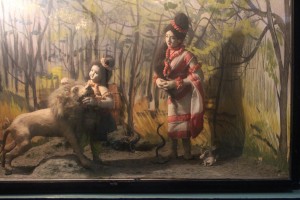
However, the collection is a vast and dusty display organised along national and ethnic lines, and includes some wonderful folk art and fabulous dioramas of the moon landing, and scenes from the Ramayana. Xavier’s favorites were the Bulgarian and Japanese collection; Mei was taken with the groovy French girls in swirling Pucci-esque body suits with fur bell-bottoms. We were invited to wait for the book shop to open in the air-conditioned comfort of the Children’s Book Library on the second floor of a wonderful cement 1960s building with wooden interiors. The library had a wall of old blond wood card index boxes and was peopled by a few old men. Entrance is free and it is a reading room for all. There was a lovely marble bust of Lenin and a little diorama.
The Museum was set up by a famous political cartoonist who collected dolls: K. Shankar Pillai (1902-1989)
(from WIki) The Museum was ready in 1965 and it was inaugurated by the then President of India, Dr. S. Radhakrishnan, who appropriately named the building, ‘Nehru House’ after the late Prime Minister. The Museum started with a thousand dolls. Between 1965 and 1987 another five thousand were added-a vast majority coming as gifts. Today the volume has increased to 6,500 exhibits from almost eighty-five countries, giving it a truly international character.
The Museum is listed in the itinerary of all visitors to Delhi. Some of the important dignitaries who have visited the Museum and recorded their appreciation are: U. Thant, the then Secretary General of United Nations, Madame Tito of Yugoslavia, Queen Frederika of Greece, the Queen of Thailand, the sister of Shah of Iran (!!), the wives of the President of Mexico and Indonesia, of the Prime Ministers of Poland and South Korea and the UN Secretary General and cultural delegations from many countries.
http://www.childrensbooktrust.com/sicc.htm
As we drove down the busy road from the Museum we passed the building of The Times of India banner. I was annoyed that I could not get a picture, and could not go back as the road was too busy.
Later in the day we went to a couple of bookstores in Khan Markets (more on that later) where I picked up the collected works of Kashmiri-American poet Agha Shadid Ali (quoted earlier) for the princely sum of 350 Rps, which is about $5. There is no tax on books in India and it is rich in titles and all kinds of bargains if you are not going to Srinigar and Ladakh for the next 2.5 months dragging your bags behind you.
I Dream It is an Afternoon when I Return to Delhi
At Purana Qila I am alone, waiting
for the bus to Daryanganj. I see it coming,
but my hands are empty.
“Jump on, jump on,” someone shouts,
“I’ve saved this change for you
for years. Look!”
A hand opens, full of silver rupees.
“Jump on, jump on.” The voice doesn’t stop.
There’s no one I know. A policeman,
handcuffs silver in his hands,
asks for my ticket.
I jump off the running bus,
sweat pouring from my hair.
I run past the Doll Museum, past
headlines on the Times of India
building, PRISONERS BLINDED IN A BIHAR JAIL, HARIJAN VILLAGES BURNED BY LANDLORDS.
Panting, I stop in Daryaganj,
outside Golcha Cinema.
Sunil is there, lighting
a cigarette, smiling. I say,
“It must be ten years, you haven’t changed,
it was your voice on the bus!”
He says, “The film is about to begin,
I’ve bought an extra ticket for you,”
and we rush inside:
Anarkali is being led away,
her earrings lying on the marble floor.
Any moment she’ll be buried alive.
“But this is the end,” I turn
toward Sunil. He is nowhere.
The usher taps my shoulder, says
my ticket is ten years old.
Once again my hands are empty.
I am waiting, alone, at Purana Qila.
Bus after empty bus is not stopping.
Suddenly, beggar women with children
are everywhere, offering
me money, weeping for me.
The poem appears in his collection The Half-Inch Himalayas.
Agha Shahid Ali, Kashmiri-American poet, 1949 – 2001
Agha Shahid Ali: StationeryThe moon did not become the sun. Write to me. “Stationery” is from The Half-Inch Himalayas (Wesleyan University Press, 1987). |

Recent Comments