Posts in Category: Mei
Arc de Triomphe (new content!)
I posted the film of the first time we set our eyes on the Mona Lisa the other day, and then we saw it again with the kids. The crowd was four times as big on the Monday, than on the Sunday. Somehow we discovered that the average time each person actually gazes on ‘IT’ is 15 seconds … hmmm, and it’s warped a little over time. Now it’s behind bullet proof glass etc etc and in a climatically controlled space (hell, as you would expect !).
Yesterday we walked up the Arc de Triomphe. I was NOT HAPPY as, after having a generational dispute with son over navigation he called me ‘POPS’ (with some spite). Now I call him JUNIOR and have asked him to find a new partner for Europe’s highest and fastest roller coaster, which awaits me just outside Barcelona. Last night Meiduo asked, ‘What’s wrong old man?’ as she stole my dessert.
She is now BUBS.
Anyway, yesterday we went to the The Arc de Triomphe. I had no real sense of what it actually was, except something for the cyclists to enjoy as they finished le Tour. Now I know it is a war memorial in the world weary sense of the words – it honours those who fought and died for France in the French Revolutionary and the Napoleonic Wars, with the names of all French victories and generals inscribed on its inner and outer surfaces. Beneath its vault lies the Tomb of the Unknown Soldier from World War I. It is also a great place to view the Haussmann layout … the l’Étoile … for this magnificent city.
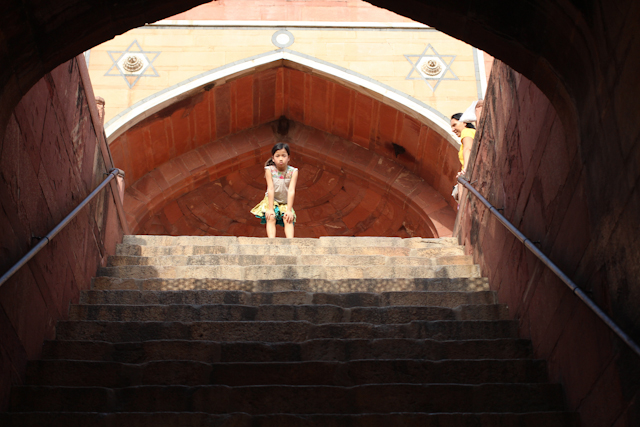
It is impressive in all its physical and cultural dimensions … and like many great monuments, I discovered you can actually climb over the thing. And like all really great monuments, that does entail a rather arduous set of steps … though post-India, the family cruise up these no worries. Meiduo actually scampers and counts at the same time.
You can share some of the experience …
http://youtu.be/TIQohjOeCKU
From THE WIKI:
The Arc de Triomphe is the linchpin of the historic axis (Axe historique) – a sequence of monuments and grand thoroughfares on a route which goes from the courtyard of the Louvre, to the Grande Arche de la Défense. The monument was designed by Jean Chalgrin in 1806, and its iconographic program pitted heroically nude French youths against bearded Germanic warriors in chain mail. It set the tone for public monuments, with triumphant patriotic messages.
The monument stands 50 metres in height, 45 m wide and 22 m deep. The large vault is 29.19 m high and 14.62 m wide. The small vault is 18.68 m high and 8.44 m wide. It was the largest triumphal arch in existence until the construction of the Arch of Triumph in Pyongyang, in 1982. Its design was inspired by the Roman Arch of Titus. The Arc de Triomphe is so colossal that three weeks after the Paris victory parade in 1919, (marking the end of hostilities in World War I), Charles Godefroyflew his Nieuport biplane through it, with the event captured on newsreel.
Couldn’t resist this:

Gompas?
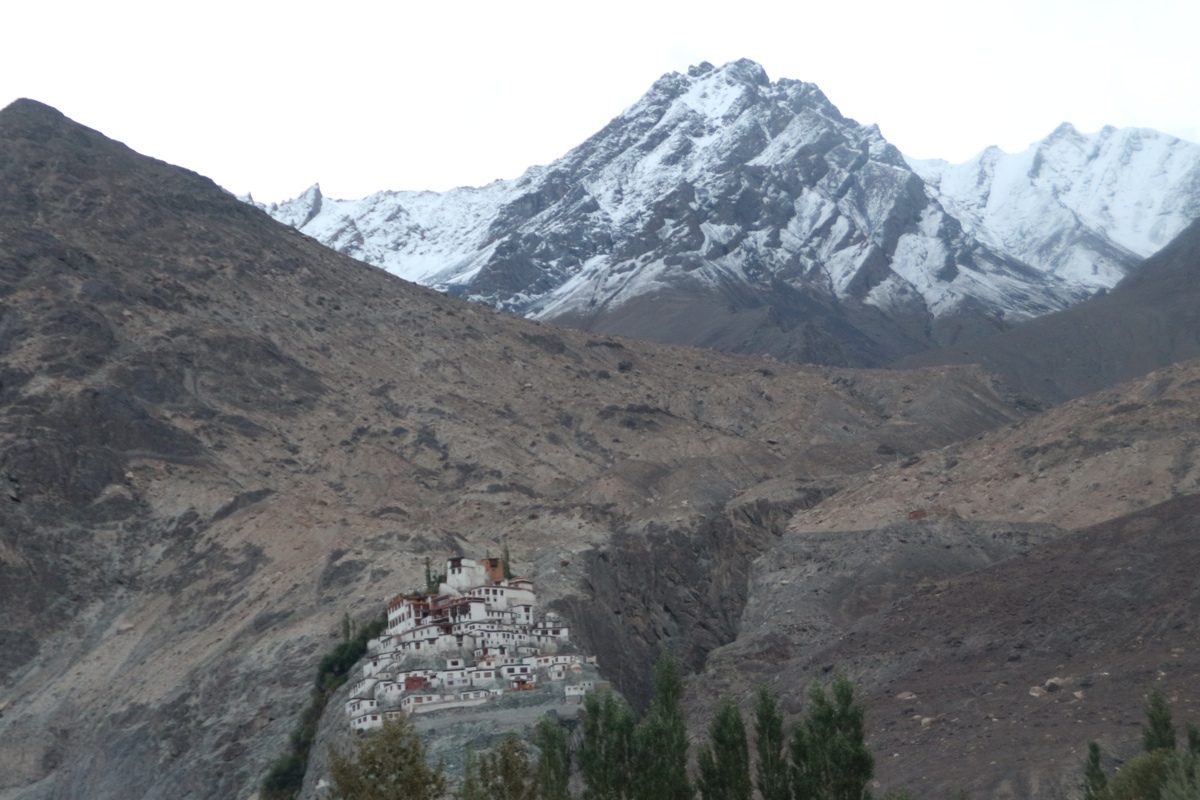
Thankyou Amanda and Angela! I have just discovered that Josie was actually stepping into a temple … not a ‘Gompa’ … the Hundar Gompa was actually a hundred metres below us. Sorry! It was the 14th century Lachung Temple, one of the oldest temples in the Nubra, the temple has a huge idol of Tsong-kha-pa, crowned with a Gelugpa yellow hat – it took our breathe away,
A Gompa (Tibetan: དགོན་པ།) might best be understood as a conflation of a fortification, a monastery or nunnery, and a university located in Tibet, India, Nepal, and Bhutan. Their design and interior details vary from region to region, however, all follow a general sacred geometrical mandala design of a central prayer hall containing a representation of Buddha or thangka, benches for the monks or nuns to engage in prayer or meditation and attached living accommodation. The siting and aspect of the Gompa, satellite buildings and grounds are founded on ancient principles of geodesic lore and environmental metaphysics. A gompa can also be just a meditation room or hall, without the attached living quarters. Meditation rooms in urban Buddhist centres are often referred to as gompas. They are a tradition in Ladakh. [this is mainly from Wiki].
A major part of travel and tourism here is visiting the different Gompas that sit along the valleys. Often they contain extraordinarily beautiful art: statues, wall paintings or thangkas – paintings on silk. They are remarkable in the way they stand high above the valley floors. From the roof of one you can usually see another up the valley.
I suppose they are a little like churches, or monasteries. They often contain displays of artefacts as well … there are always surprises! Snow Leopard skin masks … the odd human skull bowl … etc
We were seduced by Diskit Gompa in the Nubra Valley and visited it for ‘prayers’ one early morning. The Lamas (monks) were particularly welcoming and we will be supporting a young lama at the Gompa’s school.
Recent Comments